
Table of Contents
How much does it really cost to open a restaurant?
It sounds like a simple question. In practice, there is no single number that applies to every restaurant. A counter-service café moving into a previously equipped space has a different capital profile from a full-service restaurant building a kitchen from an empty shell. Even two projects with similar menus can require very different budgets because of their locations, leases, utilities, and local requirements.
Restaurant startup costs depend on the concept, location, size, condition of the space, construction scope, equipment requirements, service model, local regulation, staffing plan, opening inventory, financing structure, and working-capital needs. A useful estimate must describe the restaurant being planned rather than borrowing a broad industry number and treating it as a promise.
The real planning question is not simply whether enough money exists to open the doors. It is whether the restaurant can open with enough capital remaining to operate responsibly afterward.
1. Concept Development and Professional Planning
Early planning turns an idea into a project that can be evaluated. This category may include concept development, feasibility work, business planning, legal setup, accounting, professional consultants, early architectural or design work, and project planning.
These costs are easy to underestimate because they arrive before construction and equipment make the project feel tangible. Yet early decisions influence almost every later category. The menu affects the kitchen. The service model affects staffing, technology, and dining-room design. The financial model affects the amount of capital that must be protected for operations.
Spending modestly on focused planning can prevent much more expensive mistakes later. The goal is not to produce paperwork for its own sake. It is to identify assumptions, responsibilities, constraints, and unanswered questions before commitments become difficult to reverse.
2. Location and Lease Costs
A location can begin consuming cash well before it produces revenue. Typical costs may include deposits, first rent payments, lease negotiations, legal review, utility deposits, due diligence, site evaluation, and, in some transactions, key money or acquisition-related payments. Rent may also continue throughout construction and pre-opening.
The lease deserves more attention than its monthly base rent. Delivery condition, tenant-improvement responsibilities, permitted use, escalation clauses, maintenance obligations, renewal terms, and the timing of rent commencement can materially affect the project.
Lease economics shape the restaurant before the first guest arrives. A lower headline rent does not automatically make a space less expensive if the building requires extensive work or the tenant accepts responsibilities that would otherwise belong to the landlord.
3. Design and Construction
Design and construction can include architectural plans, engineering, permitting-related design, demolition, plumbing, electrical, HVAC, flooring, walls and finishes, restrooms, fire and life-safety requirements, millwork, lighting, signage, contractor costs, and change orders.
The condition of the space can dramatically change this category. A second-generation restaurant may already have useful infrastructure, but it still requires careful verification. An empty shell may provide flexibility while demanding significantly more utility, ventilation, restroom, and code-related work.
Early estimates should distinguish visible finish choices from less visible infrastructure. Guests may notice lighting and finishes, but a project can spend heavily on grease waste, electrical capacity, mechanical systems, and fire protection before decorative work begins.
Change orders deserve separate tracking. Some are genuine discoveries; others result from incomplete information, late decisions, or coordination failures. Treating them as a named budget category makes their effect easier to see.
4. Kitchen and Bar Equipment
Equipment planning may cover cooking equipment, refrigeration, freezers, prep equipment, warewashing, ventilation and hood systems, smallwares, shelving, storage, bar equipment, ice machines, installation, and delivery.
Purchase price is only one part of the cost. Freight, rigging, utility connections, ventilation, installation, permits, startup service, and compatibility with the space all matter. A bargain unit can become expensive if it requires unexpected electrical work, does not fit through the building, or cannot be supported by the existing hood.
Used equipment may reduce the initial purchase price, but condition, warranty, parts availability, energy use, and repair risk should be considered. New equipment can offer predictability, but it still needs correct specifications and coordinated installation.
5. Dining Room and Guest-Facing Assets
Guest-facing assets include tables, chairs, booths, décor, a host stand, service stations, tabletop items, menus, uniforms, exterior presentation, signage, and other fixtures guests encounter.
These are not merely decoration. They shape comfort, flow, perceived quality, service speed, and the way the concept is understood. A beautiful chair that is uncomfortable, difficult to clean, or poorly sized for the table creates an operating problem rather than a guest-experience advantage.
Plan these assets alongside capacity and service workflow. Quantities should account for normal replacement needs, and selections should reflect how the restaurant will actually clean, store, move, and use them.
6. Technology and Operating Systems
Technology may include the point-of-sale system, payment hardware, kitchen display systems, printers, networking, internet, phones, scheduling and labor tools, accounting systems, inventory tools, reservation or waitlist systems, music or entertainment systems, and security systems.
Separate upfront hardware and setup charges from recurring subscriptions, processing costs, support fees, and connectivity. A system with a modest installation cost may carry significant ongoing expenses, while a larger initial investment may reduce certain monthly charges.
Integration also matters. Systems should support the planned workflow, produce usable information, and communicate reliably where needed. Buying individual tools without considering how they work together can create duplicate entry, reporting gaps, and training complexity.
7. Permits, Licenses, Insurance, and Compliance
This category can include business licensing, food-service permits, health requirements, building permits, fire inspections, alcohol licensing where applicable, insurance, certificates, professional fees, and other local compliance costs.
Exact requirements vary by jurisdiction, building, concept, and scope of work. The budget should therefore be based on current local guidance and qualified professional input rather than a generic checklist alone.
Timing matters as much as fees. Reviews, inspections, and approvals can affect construction sequencing and the opening date. A delayed approval may create additional rent, payroll, financing, or contractor costs even when the permit fee itself is modest.
8. Pre-Opening Payroll, Training, and Inventory
Restaurants begin spending on operations before they begin generating normal sales. Pre-opening costs may include management payroll, hourly training payroll, recruiting, onboarding, training materials, test services, food and beverage inventory, disposables, cleaning supplies, uniforms, opening smallwares, and pre-opening marketing.
Training time should reflect the service model and the experience level of the team. A rushed opening may reduce payroll on paper while increasing mistakes, waste, guest dissatisfaction, and early turnover.
Opening inventory also needs discipline. The restaurant needs enough product and supplies to operate, but excessive opening orders tie up cash and create spoilage or storage pressure. Build quantities from menus, expected demand, delivery schedules, and practical par levels.
9. Working Capital
Working capital is the money available after startup and opening expenses to support operations while the restaurant stabilizes. It may need to cover payroll, rent, utilities, replenishment, repairs, marketing, insurance, debt service, slower-than-expected sales, and unexpected operating expenses.
OPENING BUDGET ≠ WORKING CAPITAL
The opening budget is the money required to get the restaurant open. Working capital is the money available to keep operating afterward.
A project can be fully built and still be undercapitalized. Construction overruns, opening delays, or late equipment purchases often pull money from the working-capital reserve because that cash appears available. Doing so may solve an immediate project problem while weakening the restaurant during its most vulnerable operating period.
The goal is not to prove that the restaurant can open. The goal is to determine whether it can open and continue operating responsibly.
There is no universal number of months that fits every operation. Appropriate working capital depends on the cost structure, financing commitments, sales ramp, seasonality, payment timing, and the amount of uncertainty in the plan. Model it explicitly rather than treating it as whatever remains.
10. Contingency
Restaurant projects involve many connected decisions, vendors, approvals, and physical conditions. Contingency recognizes that complex projects rarely unfold exactly as originally estimated.
Possible uses include hidden construction conditions, permitting delays, equipment changes, freight, unexpected code requirements, change orders, delayed opening, additional training, and price changes.
Contingency is not permission to overspend. It should be visible, protected, and governed. When it is used, document why. That keeps uncertainty from disappearing into unrelated categories and makes the remaining risk easier to understand.
A construction budget should not quietly consume the money intended to operate the business after opening.
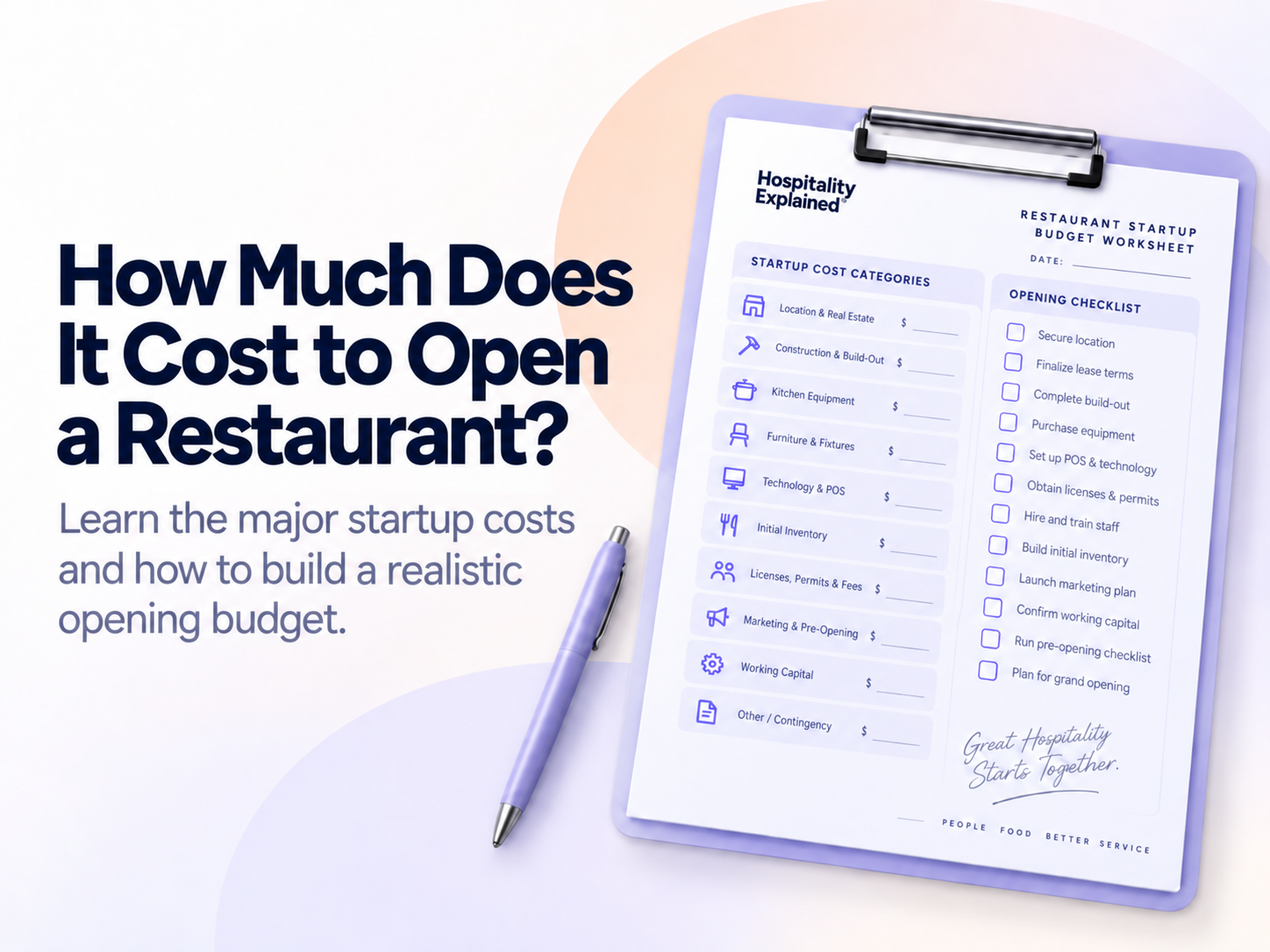
How to Calculate a Restaurant Startup Budget
Estimate each category individually, using information that reflects the actual concept and site. A practical framework is:
+ Location / Lease
+ Design & Construction
+ Equipment
+ Guest-Facing Assets
+ Technology
+ Licenses / Insurance / Compliance
+ Pre-Opening Payroll & Inventory
+ Working Capital
+ Contingency= Estimated Capital Requirement
Begin by gathering actual quotes where possible. Label every number as an early allowance, current estimate, vendor quote, contract commitment, or amount already spent. This prevents a rough assumption from quietly being treated as a fixed cost.
- Distinguish estimates from committed costs.
- Update assumptions as information improves.
- Separate one-time startup costs from recurring operating expenses.
- Track what has already been spent, not only what remains.
- Maintain contingency as its own controlled amount.
- Protect working capital from being casually absorbed into construction overruns.
A budget is not a one-time spreadsheet completed at the beginning of the project. It is a living control document. As bids, leases, timelines, and operating assumptions become clearer, the capital requirement should be revised and the effect on remaining working capital should be reassessed.
The Better Question
Instead of asking only, “How much does it cost to open a restaurant?” ask:
What will it cost to open this restaurant, in this location, under this operating model, and how much capital will remain afterward?
That question produces a more useful planning process. It connects the buildout to the business that must operate after opening and makes uncertainty, tradeoffs, and remaining capital visible before they become urgent.