
In this article
- Introduction
- 1. What Is Labor Cost Percentage?
- 2. What Should Be Included in Labor Cost?
- 3. The Labor Cost Percentage Formula
- 4. Labor Dollars vs. Labor Percentage
- 5. Why Labor Percentage Can Rise Even When Labor Cost Does Not
- 6. Is There a Good Labor Cost Percentage?
- 7. What Can Cause Labor Cost Percentage to Increase?
- 8. Labor Cost Is Not the Same as Productivity
- 9. Cutting Labor Can Create Another Problem
- 10. How to Investigate a Labor-Cost Problem
- 11. How Labor Cost Connects to Prime Cost
- 12. How Often Should Labor Cost Be Reviewed?
- 13. The Better Question
Introduction
Labor is one of the most closely watched restaurant costs. Operators frequently ask, “What should my labor percentage be?” But that question skips several important issues.
What costs are included in labor? What sales number is being used? Did labor dollars actually increase, or did sales fall? Was overtime involved? Did staffing or wage rates change? Was additional labor intentional? Did productivity or the guest experience change?
Labor cost percentage describes the relationship between labor cost and sales for the same period. Knowing the percentage is useful. Understanding why it moved is more useful.
1. What Is Labor Cost Percentage?
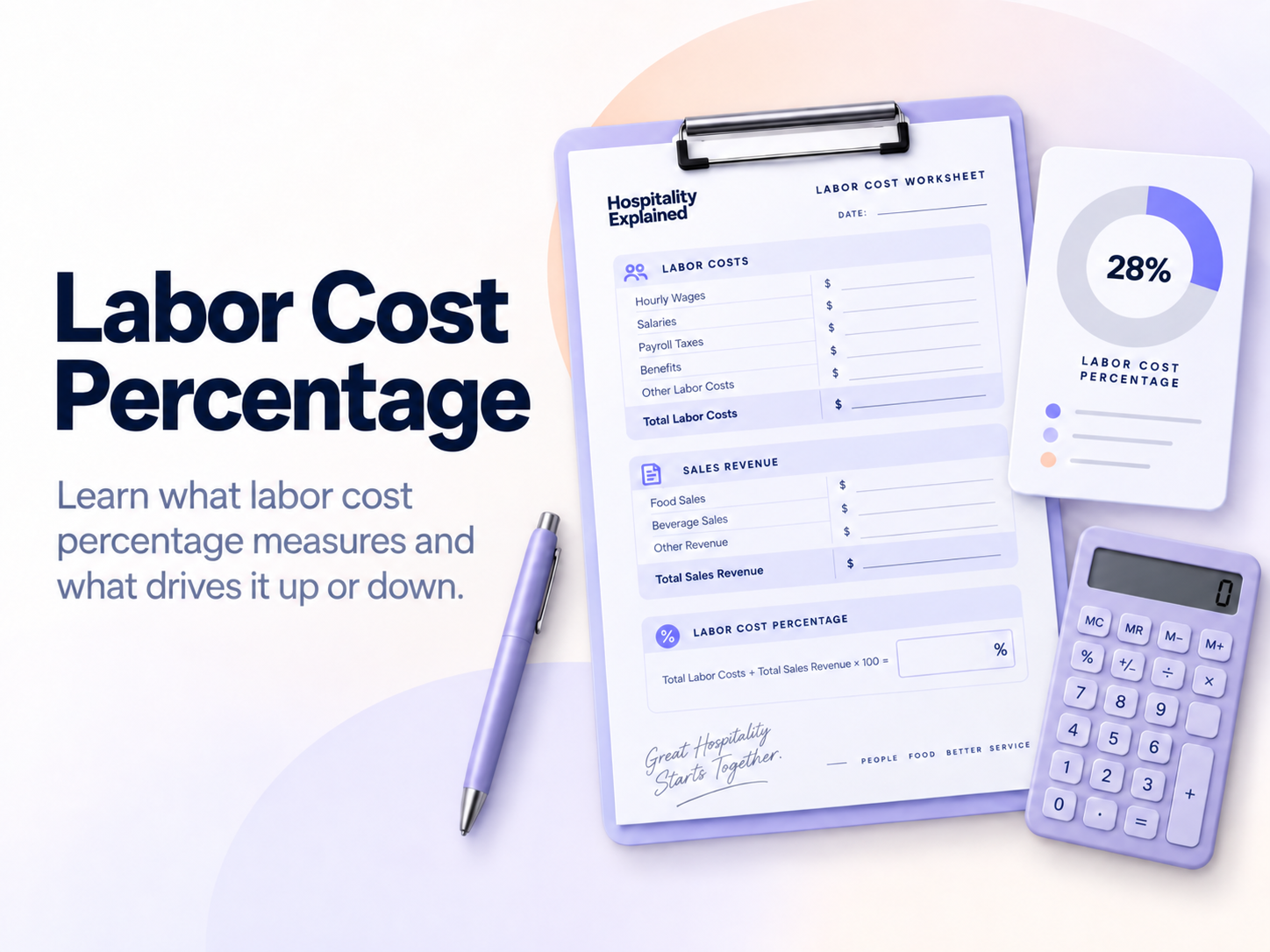
Labor Cost Percentage expresses labor cost as a percentage of restaurant sales for the same period.
Labor Cost÷Net Sales× 100=Labor Cost %
If labor cost is 32%, approximately 32 cents of each sales dollar in that period was represented by the labor costs included in the calculation.
2. What Should Be Included in Labor Cost?
Accounting practices differ. Depending on the restaurant’s reporting structure, labor can include hourly wages, salaries, overtime, employer payroll taxes, benefits, workers’ compensation or similar labor-related costs, bonuses or incentives, and other directly attributable labor costs.
Different businesses may define loaded labor differently. One accounting treatment is not universally required for every operational comparison. The most important operating principle is consistency.
If payroll taxes and benefits are included this period, comparisons should use the same definition in other periods. Otherwise, the apparent movement may reflect a reporting change rather than an operating change.
3. The Labor Cost Percentage Formula
Labor Cost Percentage
Labor Cost÷Net Sales× 100=Labor Cost %
Consider a hypothetical operating period:
- Net Sales
- $100,000
- Labor Cost
- $32,000
- Calculation
- $32,000 ÷ $100,000 × 100
- Labor Cost
- 32.0%
Approximately 32% of the sales in this hypothetical period was consumed by the labor costs included in the calculation. The remaining percentage is not profit; the restaurant must still support all other costs and obligations.
4. Labor Dollars vs. Labor Percentage
Labor dollars and labor percentage are related, but they are not interchangeable.
Period A
- Sales
- $100,000
- Labor
- $32,000
- Labor %
- 32.0%
Period B
- Sales
- $115,000
- Labor
- $34,000
- Labor %
- ≈ 29.6%
$34,000 ÷ $115,000 × 100 ≈ 29.6%.
Labor dollars increased by $2,000, but labor percentage improved because sales increased faster than labor cost. “Labor went up” and “labor percentage went up” are not the same statement.
5. Why Labor Percentage Can Rise Even When Labor Cost Does Not
Period A
- Sales
- $100,000
- Labor
- $32,000
- Labor %
- 32.0%
Period B
- Sales
- $90,000
- Labor
- $32,000
- Labor %
- ≈ 35.6%
$32,000 ÷ $90,000 × 100 ≈ 35.6%.
Labor dollars did not increase. The percentage increased because sales declined.
This does not mean staffing should never be adjusted. It means the denominator must be understood before diagnosing the cause.
6. Is There a Good Labor Cost Percentage?
Commonly discussed labor percentages exist, but no single target automatically defines a healthy operation.
A useful target depends on the concept, service model, wage market, operating hours, sales volume, average check, menu complexity, kitchen production model, management structure, level of service, training model, daypart mix, guest expectations, technology, and the broader restaurant economics.
A lower percentage is not automatically better. The result must be interpreted alongside service quality, throughput, employee workload, sales, contribution dollars, and the rest of the operating model.
7. What Can Cause Labor Cost Percentage to Increase?
Labor-dollar drivers
- Wage-rate increases
- Overtime
- Additional staffing or management coverage
- Training and turnover
- Bonuses
- Benefits or payroll burden
- Inefficient deployment
Sales drivers
- Lower guest counts
- Lower average check
- Weaker dayparts
- Seasonality
- Weather or events where relevant
- Sales mix
- Operating-hour changes
Productivity and operating drivers
- Scheduling beyond demand
- Poor forecasting
- Excessive prep time
- Inefficient station setup
- Unnecessary complexity
- Slow service processes
- Poor role clarity
- Low throughput
Several drivers can occur at the same time. An increase may reflect higher wage rates, additional hours, weaker sales, or a combination of those changes.
8. Labor Cost Is Not the Same as Productivity
Labor percentage alone cannot fully measure productivity. A team may have a relatively low percentage because sales are unusually high. Another team may have a higher percentage because it is training new employees, opening a daypart, supporting a more labor-intensive service model, or intentionally adding capacity.
Useful companion questions include:
- How many labor hours were used?
- What sales were produced?
- What work was completed?
- Was service quality maintained?
- Was throughput appropriate?
- Was overtime necessary?
- Was the staffing plan aligned with demand?
Sales per labor hour can provide another productivity lens, but it still requires operating context. No single productivity measure explains the entire result.
9. Cutting Labor Can Create Another Problem
Reducing labor can improve the percentage mathematically while damaging speed of service, cleanliness, food quality, guest recovery, employee workload, retention, upselling, throughput, and operating consistency.
The goal should be appropriate labor deployment rather than indiscriminate labor cutting: aligning the right people, hours, skills, and coverage with actual demand and required standards.
10. How to Investigate a Labor-Cost Problem
Treat labor-cost analysis as a diagnostic process:
- Confirm the labor definition.
- Confirm the sales period.
- Compare labor dollars and labor percentage separately.
- Determine whether sales changed.
- Review hours worked.
- Review wage-rate changes.
- Identify overtime.
- Compare staffing with demand by daypart.
- Look for productivity or process issues.
- Test realistic operating responses.
- Monitor the result.
Ask whether labor dollars rose, sales fell, or both happened. Check whether staffing hours or wage rates changed, where overtime was concentrated, whether a specific daypart drove the variance, whether complexity increased, and whether service performance changed.
The objective is not a simplistic “cut labor by X%” prescription. It is to identify the drivers and test a response that improves the economics without creating another operating problem.
11. How Labor Cost Connects to Prime Cost
Labor is one half of the prime-cost relationship.
COGS+Labor=Prime Cost
- COGS
- 28%
- Labor
- 32%
- Prime Cost
- 60%
Improving labor while food cost deteriorates may leave combined prime cost unchanged or worse. This is why food and labor should eventually be evaluated together. Read Prime Cost Explained: How Food and Labor Costs Work Together for the full relationship.
12. How Often Should Labor Cost Be Reviewed?
There is no universal cadence. Useful review frequency depends on data availability, payroll cycles, operating volatility, staffing changes, sales volatility, management rhythm, and whether a problem is actively being investigated.
The key principles are consistent definitions, consistent date ranges, and review that is timely enough to identify meaningful changes. Comparing mismatched periods or changing the labor definition weakens the analysis.
13. The Better Question
This shifts the conversation from benchmark chasing to operating diagnosis. It connects the percentage to labor dollars, sales, staffing, productivity, and the operating consequences of a change.