
In this article
- Introduction
- 1. What Goes Into a Menu Price?
- 2. Start With Accurate Recipe Cost
- 3. Pricing From a Target Food Cost
- 4. Pricing From a Maximum Direct Cost
- 5. Contribution Dollars Matter Too
- 6. Why a Lower Food Cost Percentage Is Not Automatically Better
- 7. The Guest Still Has to Accept the Price
- 8. Price Ceilings and Operating Constraints
- 9. Portion Decisions Can Change the Economics
- 10. Menu Pricing Is Also a Menu-Mix Decision
- 11. When Should a Menu Price Be Revisited?
- 12. A Practical Menu Pricing Process
- 13. The Better Question
Introduction
“How much should I charge for this menu item?” sounds like a straightforward question. It is tempting to start with ingredient cost, apply a markup, and treat the result as the answer. That approach is incomplete.
A viable restaurant price may need to account for recipe and direct cost, yield, portions, packaging where applicable, labor implications, contribution toward overhead, concept positioning, market context, guest expectations, menu mix, and perceived value.
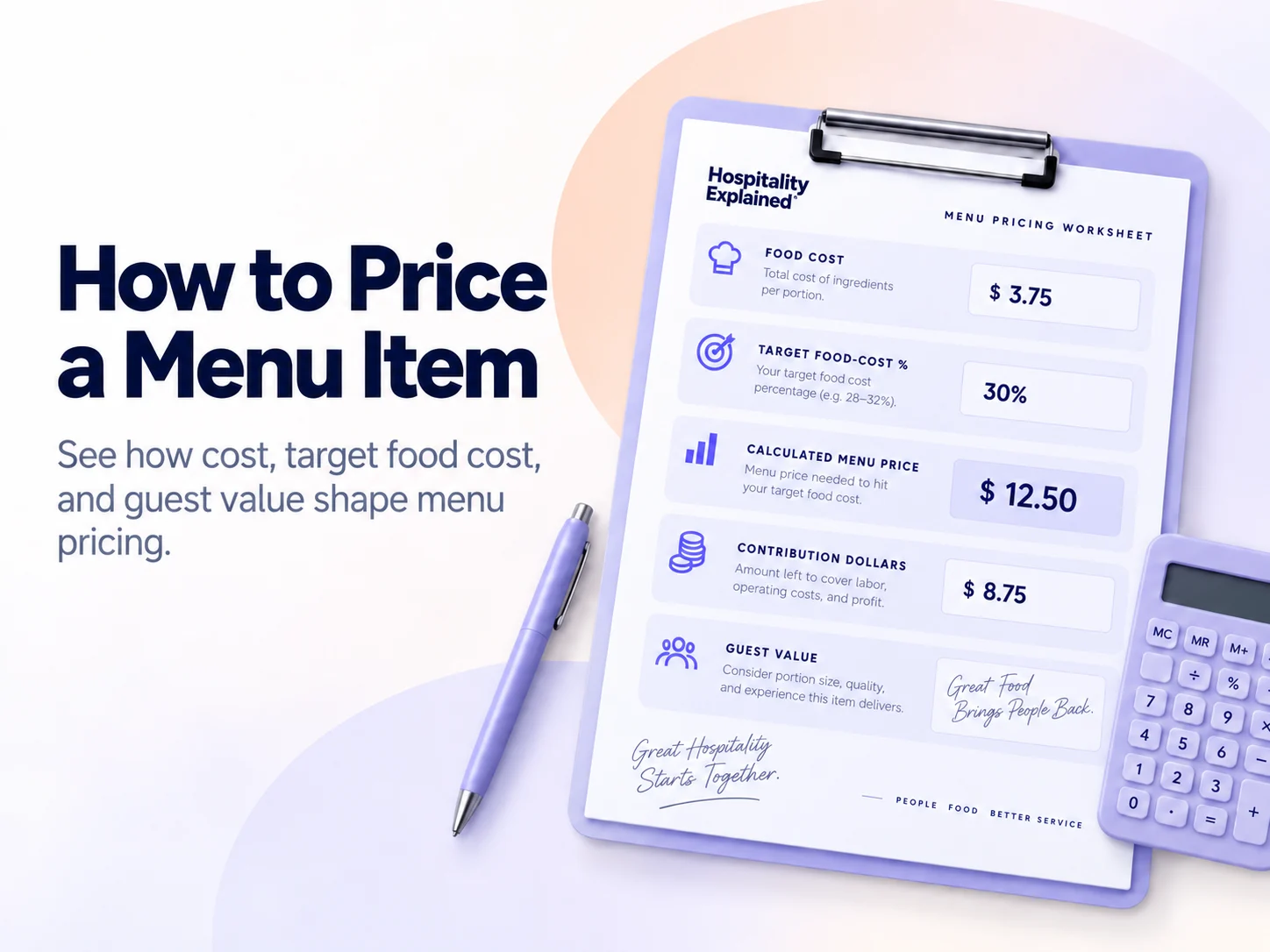
Pricing therefore involves two related but different things: mathematical price references and the actual operating decision. The math helps define the decision. It does not make the decision by itself.
1. What Goes Into a Menu Price?
Direct recipe cost is an essential starting point, but it is not the entire price. Portions and yield determine how much usable product each sale consumes. Contribution dollars help the operation support labor, occupancy, utilities, and other costs that are not allocated directly to one plate.
The broader operating model matters too. A labor-intensive service style, complex production process, concept positioning, menu mix, and guest expectations can all affect what a viable price needs to accomplish.
Competitive pricing can provide context, but it does not prove what this restaurant should charge. Competitors may have different costs, volumes, portions, service standards, or financial structures.
2. Start With Accurate Recipe Cost
Bad cost data produces bad pricing decisions. A recipe cost is only useful when its purchase quantities, unit conversions, yield, usable cost, recipe quantity, and portion size are reliable.
If an operator prices from the invoice unit instead of the usable unit, ignores trim or cooking loss, or relies on an outdated portion, the calculated price may look precise while resting on a weak input.
The Food Cost Calculator can help calculate recipe and portion cost before evaluating a price.
3. Pricing From a Target Food Cost
One mathematical reference divides cost per portion by the intended food-cost percentage.
Price at Target
Cost Per Portion÷Target Food Cost %=Price at Target
For a hypothetical Signature Wings item:
- Cost per portion
- $5.19
- Target
- 30%
- Calculation
- $5.19 ÷ 0.30
- Price at target
- $17.30
$17.30 is the mathematical selling price required for a 30% recipe food cost at the current direct cost. It is not automatically the correct menu price, and 30% is not a universal target.
4. Pricing From a Maximum Direct Cost
The equation can also be reversed to evaluate the direct cost supported by an existing price.
Menu Price×Target Food Cost %=Maximum Direct Cost
- Menu price
- $15.00
- Target
- 30%
- Maximum direct cost
- $4.50
- Current cost
- $5.19
- Gap
- $0.69
$15.00 × 0.30 = $4.50. The current recipe sits $0.69 above the maximum direct cost implied by that reference point because $5.19 − $4.50 = $0.69.
This does not prescribe the response. It measures how far the current recipe sits from the target economics at the existing price.
5. Contribution Dollars Matter Too
Food-cost percentage is only one view. Operators should also examine the dollars remaining after direct cost.
Menu Price Less Direct Cost
$15.00−$5.19=$9.81
- Contribution Margin Before Labor & Overhead
- ≈ 65.4%
$9.81 ÷ $15.00 ≈ 65.4%. This contribution is not profit. It still has to support labor, occupancy, utilities, insurance, and the restaurant’s other operating and financial obligations.
Two items with different food-cost percentages can generate very different contribution dollars. Percentage and dollars should be evaluated together.
6. Why a Lower Food Cost Percentage Is Not Automatically Better
An operator could theoretically lower food-cost percentage by raising price, reducing portion, reducing ingredient cost, or changing the recipe. Each option can also create another problem.
A lower percentage is not automatically an improvement if it damages guest value, product quality, demand, positioning, or consistency. The operating consequences matter alongside the calculation.
7. The Guest Still Has to Accept the Price
A restaurant cannot price solely from internal economics. The price must make sense to the guest relative to portion, quality, concept, service, presentation, atmosphere, occasion, and available alternatives.
Perceived value does not mean every item must be inexpensive. It means the product and experience must credibly support the price being asked.
Competitor prices are context, not a pricing rule. Another restaurant’s price does not reveal its recipe cost, purchasing power, portion, rent, labor model, sales volume, or strategic intent.
8. Price Ceilings and Operating Constraints
The Signature Wings recipe costs $5.19 per portion. At a 30% reference target, the mathematical price is $17.30. Suppose the operator believes $15.00 is currently the highest viable menu price.
The economics then have to be solved somewhere else: recipe cost, portion, purchasing, yield, menu structure, operating model, or the target itself.
The price ceiling is an operating constraint, not proof that one specific cost-cutting response is correct.
9. Portion Decisions Can Change the Economics
Whole-unit items require operationally realistic portion decisions. Using the Signature Wings example, practical scenarios might look like this:
10 Wings
- Direct cost
- ≈ $5.19
- Current role
- Reference portion
9 Wings
- Direct cost
- ≈ $4.70
- At $15
- ≈ 31.3%
- Price at 30%
- ≈ $15.65
8 Wings
- Direct cost
- ≈ $4.20
- At $15
- ≈ 28.0%
- Price at 30%
- ≈ $14.01
These are practical scenarios, not recommendations. Eight wings is not automatically the correct answer. The operator must evaluate guest expectation, value, competitive positioning, plate composition, and the overall experience.
10. Menu Pricing Is Also a Menu-Mix Decision
Every item does not need the same food-cost percentage. One item may carry a lower percentage but modest contribution dollars. Another may carry a higher percentage but stronger contribution dollars.
Items can also play different strategic roles. Some support traffic, complement profitable beverages or sides, or help the menu serve different occasions. These relationships matter even without turning every decision into a full menu-engineering matrix.
11. When Should a Menu Price Be Revisited?
There is no universal review cadence. Useful triggers include meaningful ingredient-price changes, recipe or portion changes, packaging and direct-cost changes, concept repositioning, persistent target gaps, changing guest demand, and shifts in operating economics.
Pricing should not be reviewed only after the restaurant is already under severe pressure. Timely review gives operators more options and more opportunity to understand the result of a change.
12. A Practical Menu Pricing Process
- Verify recipe cost.
- Define the current menu price.
- Calculate current food cost.
- Calculate contribution dollars.
- Define the intended operating target.
- Calculate the mathematical price at target.
- Identify any practical price ceiling.
- Measure the economic gap.
- Test realistic price, cost, and portion scenarios.
- Evaluate guest value and concept positioning.
- Make the decision.
- Monitor what happens afterward.
This sequence keeps the formulas in their proper role: useful reference points inside a broader operating decision.
13. The Better Question
This shifts pricing away from a single formula and toward an operating decision that connects cost, contribution, constraints, positioning, and guest value.